
Short AnswerYou can sell a Whatcom County home after you have moved out of state. The harder part is not signing paperwork remotely. It is making good decisions about a property you cannot simply

Dated: July 13 2026
Views: 175
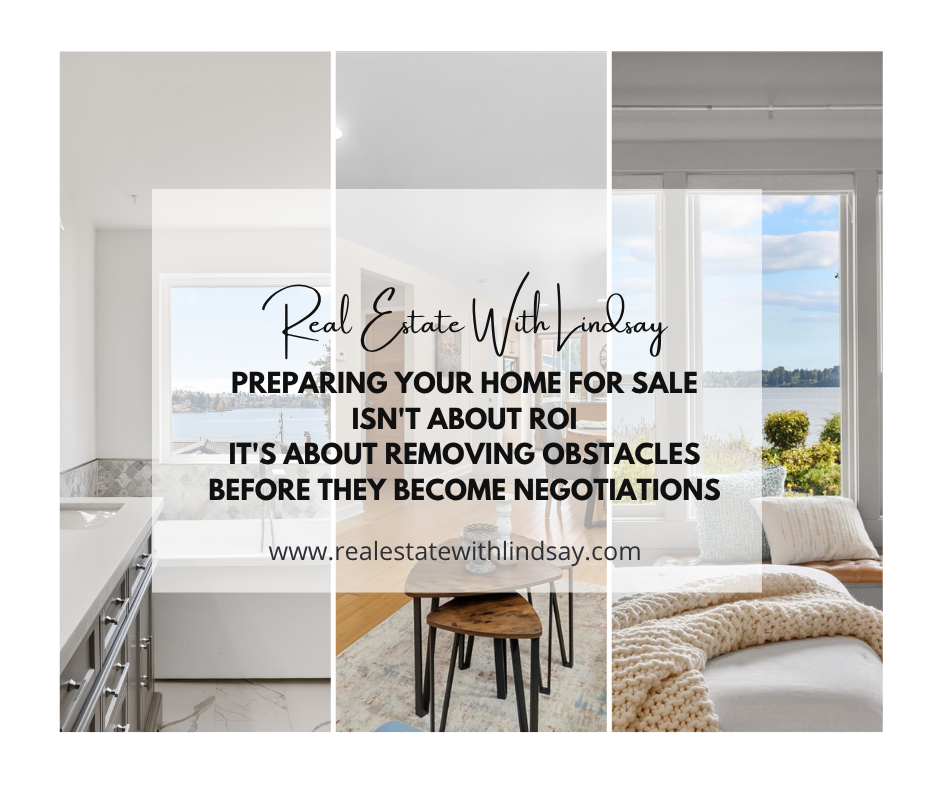
One of the biggest misconceptions I hear is that every dollar you spend before selling should increase your home's value. That's rarely how it works. Some improvements do add value, but many of the smartest decisions remove major obstacles, expand the pool of buyers, and put you in a stronger position when it's time to negotiate.
"It would really help to know the ROI before we decide what to do."
That's a question I've been talking through with sellers lately as we prepare their homes for the market.
I completely understand why they're asking.
If you're about to spend thousands of dollars replacing a roof, installing a new furnace, cleaning up landscaping, repainting, or catching up on deferred maintenance, you want to know if you'll get that money back when you sell.
My answer usually surprises people.
I'm not thinking about return on investment yet.
I'm thinking about what we're trying to accomplish.
When I'm helping sellers decide where to spend money before listing, I don't look at every project the same way.
Some improvements may increase the value of the home.
Some expand the pool of buyers who are willing and able to purchase it.
Some remove major obstacles that could create problems during financing, inspections, or negotiations.
Some simply support selling the home.
Those are all worthwhile reasons to spend money, but they aren't the same thing.
That's why I don't believe every project should be judged by whether it pays for itself.
Let's use a roof as an example.
If replacing the roof costs $20,000, does that automatically make the home worth $20,000 more?
Probably not.
But that doesn't make replacing it the wrong decision.
A roof that's nearing the end of its useful life can limit financing options. Some buyers don't have the budget to replace a roof shortly after closing. Others simply don't want to take on a major project right after moving in.
That roof may become one of the biggest topics of conversation after the inspection.
Replacing it may not increase the home's value by the full cost of the project, but it can remove one of the biggest obstacles to a successful sale.
To me, that's a return worth considering.
Many homeowners bought their homes during a market that looked very different than today's.
Back then, buyers often had very little room to negotiate. Multiple offers were common, and many buyers accepted deferred maintenance to avoid losing the house.
Today's market is different.
Buyers generally have more choices. They're taking the time to complete inspections, compare homes, and ask for repairs or credits when they find issues.
That doesn't mean homes aren't selling.
It simply means preparation matters more than it did a few years ago.
Before we list a home, I spend a lot of time thinking about what could become a point of negotiation later. If we can remove those obstacles in advance, we're often in a much stronger position once we receive an offer.
One of the biggest advantages of addressing deferred maintenance before listing is that sellers can make decisions on their own timeline rather than someone else's.
Let's use a furnace as an example.
If we already know the furnace is nearing the end of its life, we have time to gather bids, compare contractors, and decide whether an economical replacement or a higher-efficiency model makes the most sense for the home and the budget.
The same is true for a roof.
The seller gets to choose the contractor.
The seller gets to choose the materials.
The seller controls the cost.
Once we're under contract, those choices often become much more limited.
If the furnace or roof comes up during the inspection, buyers usually get their own estimates and ask for repairs or credits based on the highest of those numbers to ensure the highest-quality replacement.
Even if we decide not to complete the repair before listing, I still like gathering bids.
Knowing what something actually costs gives us better information if it comes up during negotiations. Instead of guessing what a repair credit should look like, we're providing real numbers based on bids we already received. We won't be scrambling to try to verify costs during short inspection negotiation timelines.
Preparation gives sellers more options and keeps more control over the outcome.
Once negotiations begin, those options usually become more limited and require fast decision-making, leaving little time to gather information.
I've talked more sellers out of expensive remodels than into them.
Not because updated kitchens aren't attractive.
Not because buyers don't appreciate beautiful finishes.
It's because I'd rather see sellers spend their money where it's most likely to make a difference.
Professional cleaning.
Fresh paint where it's needed.
Touching up peeling exterior paint.
Cleaning windows.
Trimming overgrown landscaping.
Taking care of deferred maintenance.
Those aren't the projects that make home renovation shows.
They're the projects that help buyers feel confident.
I've walked through homes where fresh paint and a professional cleaning completely changed a buyer's first impression. I've also shown acreage properties where buyers cared far more about the condition of the roof, fencing, shop, or outbuildings than about the kitchen countertops.
Every property is different.
That's why I'd rather have an honest conversation before someone spends the money than tell them afterward they probably didn't need to.
Preparing a home for sale isn't about making it perfect.
It's about making thoughtful decisions before buyers start making them for you.
Sometimes that means replacing a roof because it's become a major obstacle.
Sometimes it means catching up on deferred maintenance before buyers ever walk through the front door.
Sometimes it means investing in professional cleaning, fresh paint, and yard work.
Sometimes it means leaving a perfectly functional kitchen exactly as it is because buyers aren't likely to pay you back for an expensive remodel.
Every home is different.
Every seller's goals are different.
That's why I don't start with a checklist.
I start by looking at the home, today's market, the likely buyer, and what could stand in the way of getting the property sold with the fewest surprises.
Preparation gives sellers more options.
Once negotiations begin, those options usually become more limited.
Should I replace my roof before selling?
It depends on its condition, your likely buyer, and whether it could affect financing or negotiations. A roof replacement doesn't usually return its full cost in added value, but it can remove a major obstacle that keeps buyers from moving forward.
Is it worth replacing an old furnace before listing?
Sometimes it is. Replacing it before listing gives you the opportunity to compare bids, control costs, and make decisions on your timeline, rather than negotiating around someone else's estimate after an inspection.
Should I remodel my kitchen before selling?
Usually not. If the kitchen is functional and in good condition, I'd often recommend investing in deferred maintenance and presentation before undertaking an expensive remodel.
How do I know which projects are worth doing?
Every home is different. I look at the property's condition, the likely buyer, today's market, and potential obstacles before making recommendations.
If you want to talk through what buying or selling actually looks like for your situation, I'm always open to that conversation. No pressure. Just straight answers.
Lindsay Rohweder is a Managing Broker and REALTOR® with RE/MAX Whatcom County, serving Whatcom County and surrounding areas. She specializes in helping buyers and sellers navigate real estate with honest advice, clear communication, and practical strategies backed by local market knowledge. Whether working with first-time buyers, acreage properties, estate sales, or luxury homes, Lindsay's goal is to help clients make confident decisions based on facts, not pressure or headlines.
Helping sellers decide where to spend money before listing is one of my favorite parts of the process because thoughtful preparation often leads to smoother negotiations, fewer surprises, and better outcomes.

I’m a Managing Broker and real estate agent with RE/MAX Whatcom County, serving buyers and sellers throughout Whatcom County, Washington, including Bellingham, Ferndale, Lynden, Birch Bay, Blaine, S....
Short AnswerYou can sell a Whatcom County home after you have moved out of state. The harder part is not signing paperwork remotely. It is making good decisions about a property you cannot simply
Short AnswerI would market a horse or acreage property by making it easy for the right buyer to understand what the entire property actually offers, not just how the house looks. That means showing
Short AnswerTwo acreage properties with the same number of acres can have very different values because acreage is not just about quantity. I look at how usable the land is, access, terrain,,
Short AnswerSellers and buyers often see home value differently because they are looking at the same property from completely different positions. A seller naturally sees the home they have owned,
 Claims of Copyright Infringement & Related Issues
Disclaimer:
IDX information is provided exclusively for consumers' personal noncommercial use,
that it may not be used for any purpose other than to identify prospective properties
consumers may be interested in purchasing, that the data is deemed reliable but is not
guaranteed by MLS GRID, and that the use of the MLS GRID Data may be subject to an end user
license agreement prescribed by the Member Participant's applicable MLS if any and as amended
from time to time.
The information contained in this listing has not been verified by REMAX Whatcom County, Inc. and
should be verified by the buyer.
The database information herein is provided from and copyrighted by the
Northwest Multiple Listing Service (NWMLS). NWMLS data may not be reproduced or
redistributed and is only for people viewing this site. Listings that feature the
"three tree" icon are provided courtesy of NWMLS. All information provided is deemed
reliable but is not guaranteed and should be independently verified. All properties
are subject to prior sale or withdrawal. All rights are reserved by copyright.
Based on information submitted to the MLS GRID as of September 23, 2026 3:47 AM UTC. All data is obtained
from various sources and may not have been verified by broker or MLS GRID.
Supplied Open House Information is subject to change without notice.
All information should be independently reviewed and verified for accuracy.
Properties may or may not be listed by the office/agent presenting the information.
Some IDX listings have been excluded from this website.
Copyright 2026 Northwest Multiple Listing Service. All rights reserved.
